Planning for what matters – Part 2: Modern families need modern succession planning
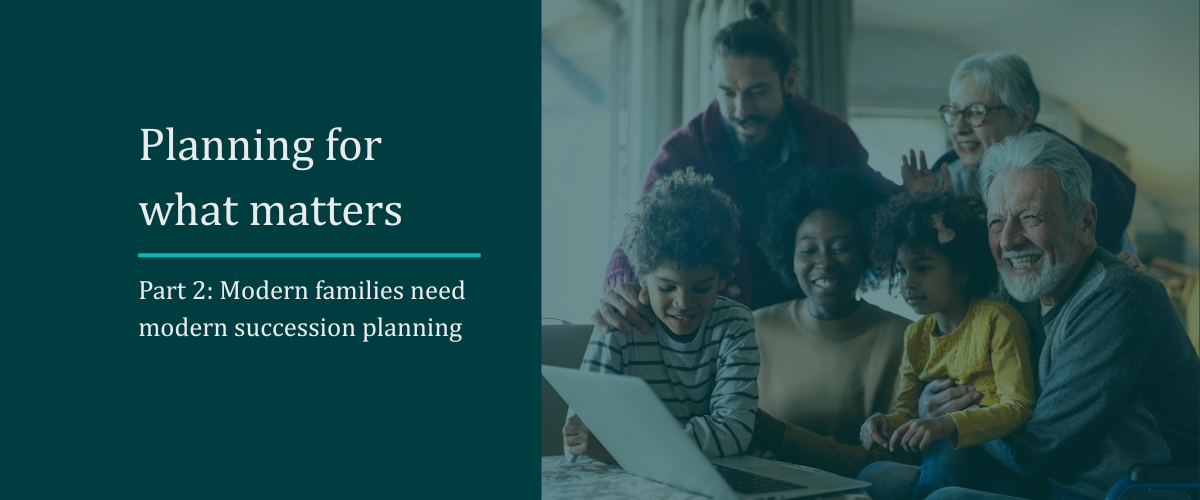
Family life has changed
Succession planning has always been shaped by family life. The difference today is that family life is more varied, more international and often more complex than traditional planning models assume.
For many families, the idea of wealth passing neatly through one straightforward family structure no longer reflects reality. Second marriages, stepchildren, children from different relationships and differing expectations around fairness are now common features of modern family life.
None of that makes planning impossible. It does mean that thoughtful, bespoke planning matters more than ever.
The challenge is often human, not technical
STEP’s research into modern families found a marked increase in complex family structures seeking wealth and succession planning advice, alongside a clear warning that legal frameworks have not always kept pace. More recently, STEP Barometer 2026 report has found that blended families are widely seen by practitioners as one of the leading causes of legal or planning challenges in succession and inheritance matters.
That finding will not surprise many families. Blended family arrangements can raise difficult questions even where relationships are positive. How should assets be divided fairly where needs differ? Should children from an earlier relationship be treated in the same way as a current spouse? What happens where a property, business interest or investment portfolio has emotional significance for one branch of the family but financial importance for another? These are rarely questions with simple or universally right answers.
Understanding the family behind the structure
The most effective succession planning begins with context.
It starts with understanding the family’s priorities, concerns and likely pressure points before deciding what framework may be appropriate. In some cases, a trust may be the right solution. In others, alternative structures may work better, particularly where there is a desire for family involvement in governance over time.
Saffery Trust has written before about the value of understanding the people behind the structure. In Contentious trusts: prevention by anticipation, the point is made clearly: long-term relationships and early understanding can help reduce the risk of conflict later on.
Why clarity matters
The challenge frequently encountered is that families often avoid these issues until circumstances force them into the open. By that point, decisions may need to be made quickly, under pressure or at a time of bereavement. Unsurprisingly, that is when misunderstanding and conflict are more likely.
Thoughtful planning can reduce that risk. Not by trying to eliminate complexity, but by acknowledging it early and designing around it. That may involve trusts, carefully drafted expressions of wishes, governance arrangements, or a wider family conversation about intentions and expectations. Just as importantly, it may involve spending more time than expected at the outset understanding the human context rather than jumping straight to technical solutions.
In blended family situations, fairness and equality are not always the same thing. Treating everybody identically may not reflect the family’s history, needs or responsibilities. Equally, differential treatment without explanation can create lasting resentment. The strongest arrangements are often those that are not only legally robust, but also clearly thought through and capable of being explained.
There is also a timing issue. Families evolve. Relationships settle. Financial positions change. New children may arrive. Businesses may be sold. International connections may develop. Planning should not be viewed as a single event, completed once and then left untouched. It is often more realistic to treat it as something that should be revisited as family life changes.
A bespoke approach is essential
This is one of the reasons a more bespoke approach matters. In modern families, context is everything. The same technical structure can achieve very different outcomes depending on the people involved, the assets being considered and the wider purpose behind the planning. A solution that works well for one family can be entirely wrong for another.
The most useful starting point is often not a product or a structure, but a conversation. What are the priorities? Who needs protecting? Where might tensions arise later? What would “fair” look like in this family, rather than in theory?
These questions can be uncomfortable, but avoiding them rarely makes them disappear. In many cases, addressing them early is one of the most effective ways to preserve harmony later.
Modern family life is more varied than ever. Good succession planning should reflect that reality with care, clarity and a willingness to engage with the details that matter most.
Get in touch

Latest Insights




The responsibility of inheriting significant art: Transforming private collections into public legacies


Planning for what matters – Part 4: Digital assets in modern succession planning